by Ben Aaron
Released in 2011, the action role-playing video game series Dark Souls has led to the creation of an entire subgenre: the “soulslike”. The action role-playing genre typically couples a narrative with the experience of the player character moving through different areas, fighting different opponents, and becoming stronger. In the words of Wikipedia, what is unique about soulslikes are “high levels of difficulty and emphasis on environmental storytelling, typically in a dark fantasy setting.”
Leading the subgenre is FromSoftware, the company responsible for developing Dark Souls. Since 2011, they’ve continued to produce games in this subgenre that receive critical acclaim. Dark Souls was voted “the Ultimate Game of All Time” at the 2021 People’s Gaming Awards. Also developed by FromSoftware, the 2022 Elden Ring was released to widespread critical acclaim, winning no less than 20 Game of the Year awards. Elden Ring was directed by Hidetaka Miyazaki, and shares many of the themes of the ‘souls’ series, which was also directed by Miyazaki. Thus, Elden Ring can be described as a “soulslike”.
While “dark fantasy” might be the term Wikipedia uses, the soulslike genre is also often described in casual gaming settings as being “Lovecraftian”, or as similar to the works of the American horror writer H. P. Lovecraft.
Harold Phillips Lovecraft was born in Rhode Island in 1890, and was an active writer of horror fiction until he died in 1937. The editors of The Medial Afterlives of H.P. Lovecraft, a collection of academic essays on Lovecraft’s legacy, write that “he and his most famous creation, Cthulhu, have become staples of popular culture.” They note that using his name in search engines will bring up a large variety of results, and that his name is now used as an adjective. They write, “If Stephen King is a filmic and literary ‘brand’, Lovecraft is more; he lends his name to an entire subgenre of horror, ‘Lovecraftian fiction,’ which is arguably only in part synonymous with weird fiction and cosmic horror.”
These editors also write that Lovecraft “always assumed white supremacy,” and this racism is made explicit in many of his stories. I don’t think it’s responsible to talk about Lovecraft at length without mentioning this racism, and I don’t want to imply that I recommend reading his work, because I don’t.
In his essay, “A Literary Copernicus”, the American fantasy author Fritz Leiber wrote that Lovecraft was the “Copernicus” of the horror story. Copernicus developed the heliocentric model of the universe, one where the earth revolves around the sun, as opposed to Christian medieval Europe’s belief that Earth was at the center.
Of course, this changed everything. Scientific knowledge exploded – this is why we call it the Copernican Revolution. And we are still living in the wake of that revolution.
Literature is one place where that revolution appears. What changed in literature was allegedly “the object of man’s supernatural fear,” which had previously been fantasized by writers like Dante Aligheiri as the devil, “together with the legions of the damned and the hordes of the dead.” As belief in Christianity waned, so too did fear of the devil, and “writers seeking to awaken supernatural fear restlessly turned to other objects, some old, some new.” With scientific materialism came a new “source of literary material…the terrifying vast and mysterious universe.” And so, science fiction.
But when Leiber called Lovecraft a literary Copernicus, he was differentiating him from other authors of horror, fantasy, and sci-fi. Compared to other massively influential writers like H. G. Wells and Edgar Allen Poe, “the main and systematic achievement was Lovecraft’s.” And what was this achievement?
Leiber writes that by the end of his literary career, Lovecraft, “had firmly attached the emotion of spectral dread to such concepts as outer space, the rim of the cosmos, alien beings, unsuspected dimensions, and the conceivable universes lying outside our own space-time continuum.”
These literary concepts also appear in Souls games and soulslikes. In these games, it’s a regular occurrence to encounter “otherworldly” beings with unknown motives who are attached to ideas of “unsuspected dimensions.”
But Leiber claims that it is the presentation of the whole “universe of science” in Lovecraft’s work, more than anything else, that instilled a “profounder” horror. And, according to Leiber, “the chief reason man fears the universe revealed by materialistic science is that it is a purposeless, soulless place.”
A “school” of graven mages from Elden Ring. Source

Elden Ring has themes that could be called Lovecraftian. For example, this mass or “school” is the result of a number of sorcerers, “graven mages,” being fused together so that they might become a star. According to the lorekeepers, the cosmic sorcerers of Elden Ring are not a happy family. There are fierce differences among them, and some of these differences are ethical. The idea of fusing together with other sorcerers to become a star seems to be one such boundary. Schools of graven mages are referred to as “the nightmare of the academy,” and “a nightmare that would continue to haunt the academy.”
The item descriptions for two “graven talismans”, items that can be equipped to boost the player’s magic ability, say this: “The primeval current is a forbidden tradition of glintstone sorcery. To those who cleave to its teachings, the act of collecting sorcerers to fashion them into the seeds of stars is but another path of scientific inquiry.”
We learn that this school pursues a “forbidden tradition,” a “nightmare” which is seen by its students as “but another path of scientific inquiry.” At the heart of this nightmarish study is something called the “primeval current.”
A forbidden nightmare || A day at the lab
The Martinican surrealist poet Aimé Césaire once wrote that scientific knowledge is a “half-starved” knowledge. In his essay “Poetry and Knowledge,” Césaire draws on a passage by Aldous Huxley, who was writing about the vital relationship between a lion and its ecosystem. Like a lion starving for lack of antelopes and zebras, scientific knowledge is “gnawed away from within” and “starved for life.”
Césaire writes that, in awe of science’s power to “classify” and “explain,” “man has sacrificed everything to acquire it: desires, fears, feeling, and psychological complexes.” Scientific knowledge is contrasted with myth, which enables love and humor: “Only myth satisfies man entirely: his heart, his reason, his taste for the fragment and the whole, his taste for the false and the true, for myth is all of these at once. A hazy and emotional apprehension…”
In describing the primeval current, VaatiVidya (a producer of video content around the stories of FromSoftware games) says it is “almost Lovecraftian in its horror.” He says, “We cant pin down the exact truth of why it terrifies, but we see its terrible effects on others and are left to wonder”, and describes it as “something so dangerous that just looking at it can damage your mind irreparably.”
Doesn’t this call to mind what Leiber describes as the “universe” of science and its cold materialism? In pursuing the scientific knowledge of the current, graven mages, in the words of Césaire, “have sacrificed everything to pursue it.”
The sorcerers Lusat and Azur, who had formerly earned the prestigious title of “grand master” before being exiled from the academy of Raya Lucaria, were also forever changed by looking at the primeval current too closely. Lusat’s mind was “broken”, and Azur was left afraid of a “darkness” he saw. This is a harmful form of inquiry, to say the least. The idea of a mind being “broken” in particular calls to mind Césaire’s description of “everything” being sacrificed.
Graven schools are… all head. This is another one.
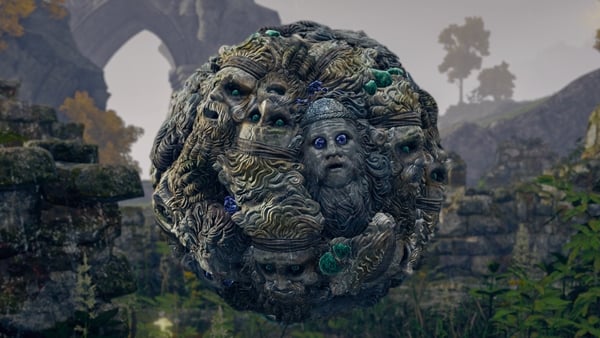
A graven school, which is encountered as an opponent in Elden Ring. Source
I think the head and the face are something like motifs in the world of sorcery in Elden Ring. In addition to faces being the only visible parts of the people fused into graven schools, the masks worn by members and students of the academy of sorcery are also designed as faces. These masks are each linked with a particular “conspectus” or school of sorcery-knowledge. Here is one such crown.
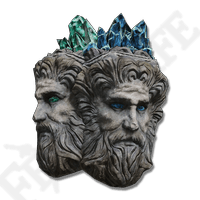
An item from Elden Ring. The “Twinsage Glintstone Crown.” Item Description: One of the glintstone crowns bestowed upon Raya Lucaria scholars whose pursuits were deemed worthy.
Greatly increases intelligence to the detriment of HP and stamina.
Scholars of the Twinsage Conspectus were the elites of the academy, permitted to study and excel in sorceries of all kinds. Source
This helmet increases the player attribute referred to as “intelligence” while decreasing ones called “HP” (Health or Hit Points) and “stamina”. The same idea: crucial things, in this case vitality and stamina, are sacrificed by the sorcerers in pursuit of knowledge. These faces are used as signs of elitism, but the intelligent and elite men who wear them are left “half-starved”.
The sociologist Avery Gordon has described haunting as a way of knowing that is not “cold knowledge” but a “transformative recognition.” Elden Ring seems to stage this kind of haunting. The primeval current’s promise of scientific knowledge is double-sided, and it transforms those who study it too obsessively into “nightmares,” or leaves them forever changed.
Thank you for reading. If you would like to support my work, please visit my ko-fi.


 Contrafiction // Wisdom is gathered here
Leave a reply to June Cancel reply