An Introduction to Caring for Houseplants
I think taking care of houseplants is easier than it’s made out to be. When I worked as a horticultural technician, people would often express amazement at how good our company’s plants looked. “Everyone thinks they’re fake,” was one of the first things my trainer told me.
I wanted to write an introduction to plant care that was comprehensive, while remaining approachable. I begin the piece by discussing some popular misconceptions or “myths” involving houseplant care, and then I turn to the basics of plant maintenance. The article ends with some recommendations for commonly available plants, based on what lightning someone has available.
Plants have been demonstrated to clean the air, and simply being around them has been shown to bring feelings of peace and contentment. My mother taught me to care for plants, and some of my most cherished memories are of us standing together and marveling at flowers. And with the increasing threats of pollution and large-scale wildfires, clean air is only becoming more important.
The beauty of plants is its own joy. And there is nothing like the feeling of watching something grow over a year, or over several years.
Plant Myths
The first myth I want to clear up is how certain people are that they will kill plants. When I started working with plants, my grandmother jokingly told me, “Just don’t kill the plants.” She found this very funny.
Plants can be quite durable, and they adapt to their environments. If given access to water, light, and air circulation, they take care of most of their own needs.
Of course, it’s true that people do kill plants. Not only have several houseplants of mine died, but I accidentally drowned a few while at my job. But this is part of it. There’s no way to learn if you don’t try. The trick is to approach failure as an opportunity to learn.
When you kill your first plant, pay attention to what happened: there is usually an easy fix. Sometimes it means that a certain plant simply cannot live in a certain spot. There may be too much light, or not enough air circulation. Less air circulation means soil stays wet, and roots can rot.
There have been times when I never learned why particular plants died. This is rare, in my experience, but it does happen.
The second myth I want to clear up is that plants can take care of themselves. Of course your plant is going to die if you literally never look at it. Some plants, like snake plants, can go months without watering.
The key is balance. For example, heart-leaf philodendrons don’t like to be too wet. If water stays in the pot too long, and the soil stays soggy, the plant will rot. It prefers to be on the drier side. But, that doesn’t mean it can go a year without being watered. Philodendron ‘brasil’ is even more sensitive, and I killed quite a few at my job.
Philodendron ‘brasil’

When you get a new plant, pay attention. Over time, you will learn how often they like to be watered, and how long it takes until they start to wilt. Plants wilt when they need water, with stems and leaves drooping and falling over. Most wilting plants will recover after being watered, though stems and leaves may be lost.
Houseplants can’t live on their own forever, but most don’t need to be doted on. There are some that do. For example, these are the delicate leaves of a maidenhair fern ‘fritz luthi’. It is incredibly sensitive, and will wilt and die quickly if its soil stays dry for too long.
Maidenhair Fern ‘Fritz Luthi’
On the other hand, this is a snake plant. It is notorious for being drought-resistant. Big ones can go several months without being watered. However, too much water will cause the plant to rot.
Snake Plant in bloom
Watering Basics
An easy watering technique for people new to plants is to water them at the sink. Just run the faucet with lukewarm water, and let the water run out the bottom. This is the basic theory. Water pooling at the bottom of pots can lead to rot, mold, and an absolutely noxious smell. You also want to let all the soil get moist, because soil that stays dry can become hyper-dry, and resistant to water (hydrophobic).
Watering routines are often maintained by simply sticking a finger into the soil, and determining how dry the soil is. Some plants like to be watered when the top inch or so of the soil is dry, while some like for the entire pot to dry out. Some never want to be dry. Each plant has its own needs.
Plants are typically sold in plastic pots with holes in the bottom, and the holes make it easy to know when water has run through the pot. Pots without holes in the bottom can be more difficult.
When people say certain plants are “easier” than others, it often has to do with watering. “Easy” plants don’t need to be watered much, and if they stay dry for a bit, they’re not going to die, or they may wilt. Snake plants and ZZ plants are very easy, whereas pothos might still be easy, but it is a little more demanding. It is thirstier.
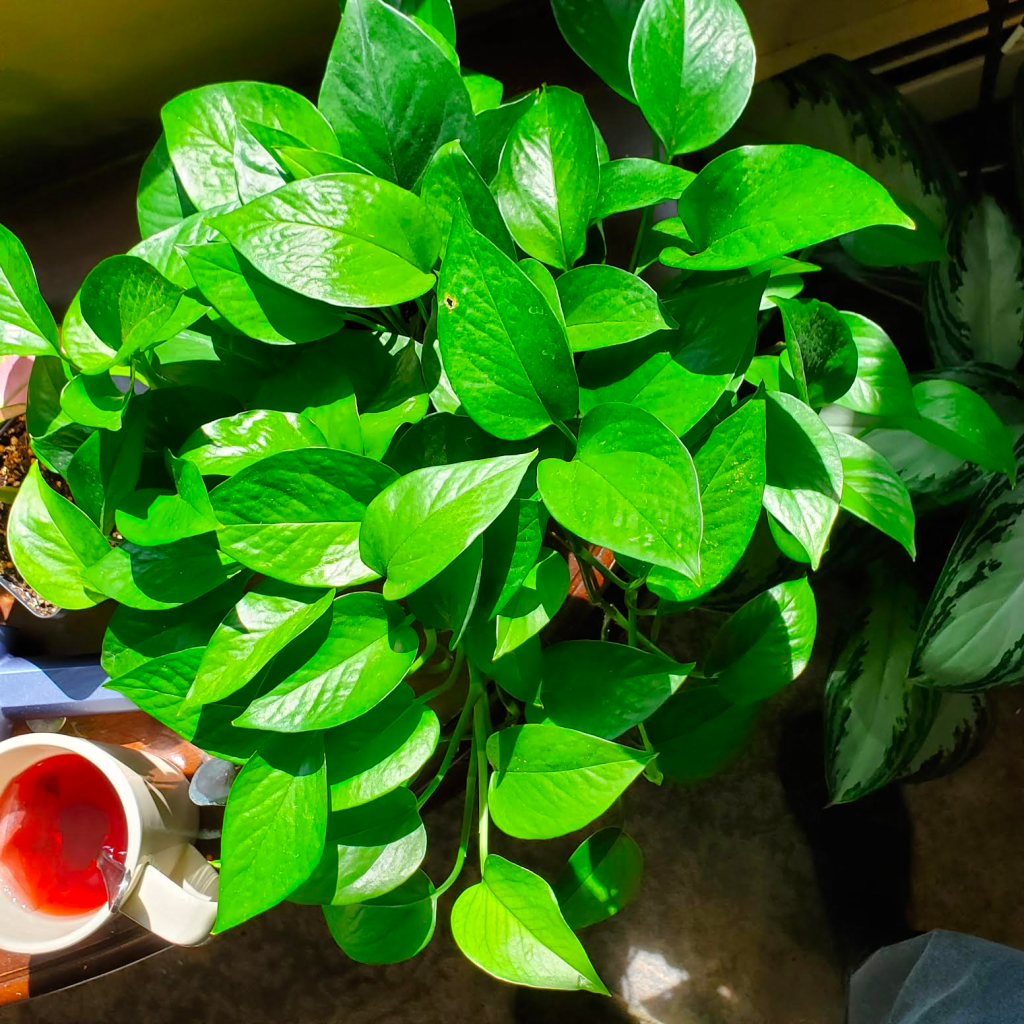
Jade Pothos
Light Basics
Lighting is key. Many plants simply cannot live in a location if it doesn’t get enough light, whereas others can survive anywhere between “high light” and “low light”. High light would be in front of a big window where the sun directly shines through for at least a few hours a day. Low light would be like a corner of a room that has one or two windows. Of course, that corner could be more like “medium light” if the windows are big, or depending on the direction they face.
Southern windows get more light in the northern hemisphere, and the same is true for northern windows in the southern hemisphere. These locations are often recommended for high light plants.
There is an important distinction between low light and no light. A dark room with no windows has no light. While working with plants, I had some dracena compacta, a plant that is very sensitive to water. These plants can tolerate low light, but with no light, water cannot evaporate.
I had several of these plants in a very dark corner, with practically no light. Many died one by one. I was new, and it is true that they may have lived if I watered them less. But, it is also true that they may have still died, because there was simply no light there. Even the ZZ plants and snake plants, which were also in that location, looked weak.
The light that is available in a particular room will change with the seasons. It can vary dramatically, at least if you’re a plant. Some more sensitive plants can be moved throughout the year. I move two of my ‘ostral gem’ ferns, which are incredibly sensitive to light. They like shade, so I have them at the very bottom of a plant trellis, almost on the floor, in a dark corner. But the corner does get some light.
Plants can also burn when the sun gets too strong, and this is becoming more of a concern with climate change.
Soil Basics
Soil is where plants get their nutrients, as well as their water. Fertilizing is usually not necessary for new plants, as they often come with “slow-release fertilizer” in the form of colored pellets that can be seen in the soil.
Fertilizing is important, eventually, but can usually be ignored for people new to plants. It can become a concern when the soil doesn’t have enough nutrients for the plant to thrive, and sometimes the plant can show this with stunted growth. But, considering that plants often come with slow-release fertilizer, it is often advised to wait a year after getting a new plant to fertilize it. All-purpose fertilizer is usually acceptable.
One of the most useful things I learned while working with plants was the relationship between light and evaporation. Some pots have “soil dressing,” like rocks, or moss, which goes on top of the soil. This is decorative, and can also have the function of slowing down how quickly the soil dries out.
Plants become easier to take care of when you learn how evaporation will work differently in different settings. For example, imagine a big pot with a bunch of moss on top, in a dark corner that doesn’t get much light. Not only is the soil covered, but it isn’t getting light, so it is going to stay wet. A snake plant in a location like this might need water every two months, or even three or four, depending on how big it is, and how much soil is in the pot.
Plant Basics
Plants can be both resilient and fragile. A plant can be given the perfect conditions to thrive, and can still seem doomed. Its caretaker might try everything, only for the plant to die from an unknown cause. Sometimes, this can be traced to roots being damaged while the plant was being transported, or the soil becoming too compacted, resulting in an absence of the air required for roots to breathe.
One thing that can affect a plant’s resilience is variegation. Variegation typically refers to changes in a plant’s appearance – sometimes colors will be lighter, or entirely different. Some plants will get spots, stripes, and all kinds of patterns.
Plants with entirely white leaves, for example, seem to consistently be quite fragile. Pinks, reds, and yellows are common colors in popular variegated plants. Variegation typically means a plant will be more fragile. They are thirstier, and need to be watered more. They also require enough sunlight to keep their variegation, and if they don’t get the proper light, they will lose the variegation. Bright pink leaves will be followed with more standard greens, and might be smaller than typical leaves.
Roots are sensitive, but sturdy. Oftentimes, when a plant stays in the same pot for too long, it will become rootbound. While it is easy to see leaves and stems grow, we do not see how the roots are constantly growing beneath the soil. Rootbound roots will spiral around the container, and eventually, the entirety of the inside will be covered in a complex web of roots. Plants are typically recommended to be repotted once every year or two, but this changes depending on the plant. When repotting, using your fingers to gently pry apart the roots, teasing them out, will ensure healthier growth in the future.

Philodendrons ‘heart-leaf’, ‘neon’, and ‘brasil’
Preparing for Plant Care
Pothos feels like the safest plant to recommend for people new to plants. It can survive in low light, but growth will slow. It likes high light and medium light best.
Pothos plants put out long vines with teardrop-shaped leaves, and come in variegations of gold, white, yellow, and neon-green. They like to be watered thoroughly, until water runs out of the bottom of the pot.
Pothos will be happy being watered when the soil completely dries out, but before it gets bone dry. This, again, will make the soil resistant to water.
ZZ plants and snake plants are happy with low light, and are often suggested for new plant owners. They require little watering, and are drought-tolerant. But they will rot fast if they stay too wet. Philodendrons are also nice, and fairly easy, but do not want to stay too wet.
Monstera are popular, and fiddle figs are becoming the plant of instragram influencers. Monstera can be a little sensitive, they like to be dry. They like high light, and can tolerate low light, but growth will slow. Fiddle figs are gorgeous, but sensitive. They demand high light and a lot of water.

Monstera Deliciosa
When I was working in horticulture, a co-worker once told me my fiddle figs all looked great. They all got the light they needed, and they had good air circulation. I drenched them in water regularly, not letting them stay dry for too long. Basically, I didn’t do much.
Plants like a light, gentle, but attentive and searching touch. Learning what particular plants need is a process, one that can be difficult, but endlessly rewarding. By beginning with easier plants, the learning process is made easier. I remember some of the plants I started out with, including succulents and ferns, and I wish I got something easier, like a pothos!
My supervisor once told me, always be thinking. Are there a lot of obstacles in the room, or is there space for air to circulate? If certain plants in an area are very dusty, and others aren’t, is there an air conditioning vent?
In this way, caring for plants can be a deep source of learning. I learned so much while working with plants, and I continue to learn from them. Caring for plants teaches tenderness, observation, patience, and curiosity. One also learns about beauty, and the cultivation of beauty.
If you would like to support my work, please visit my ko-fi.
 Contrafiction // Wisdom is gathered here
Leave a comment